Accessible without becoming shallow
No specialist background is required. Each tradition is explained through the educator it produces and the choices it makes possible.
A book by Kevin Fenemore
Fifty philosophical lenses for educators who want to understand the ideas beneath how they teach, lead and help others grow.
Get the book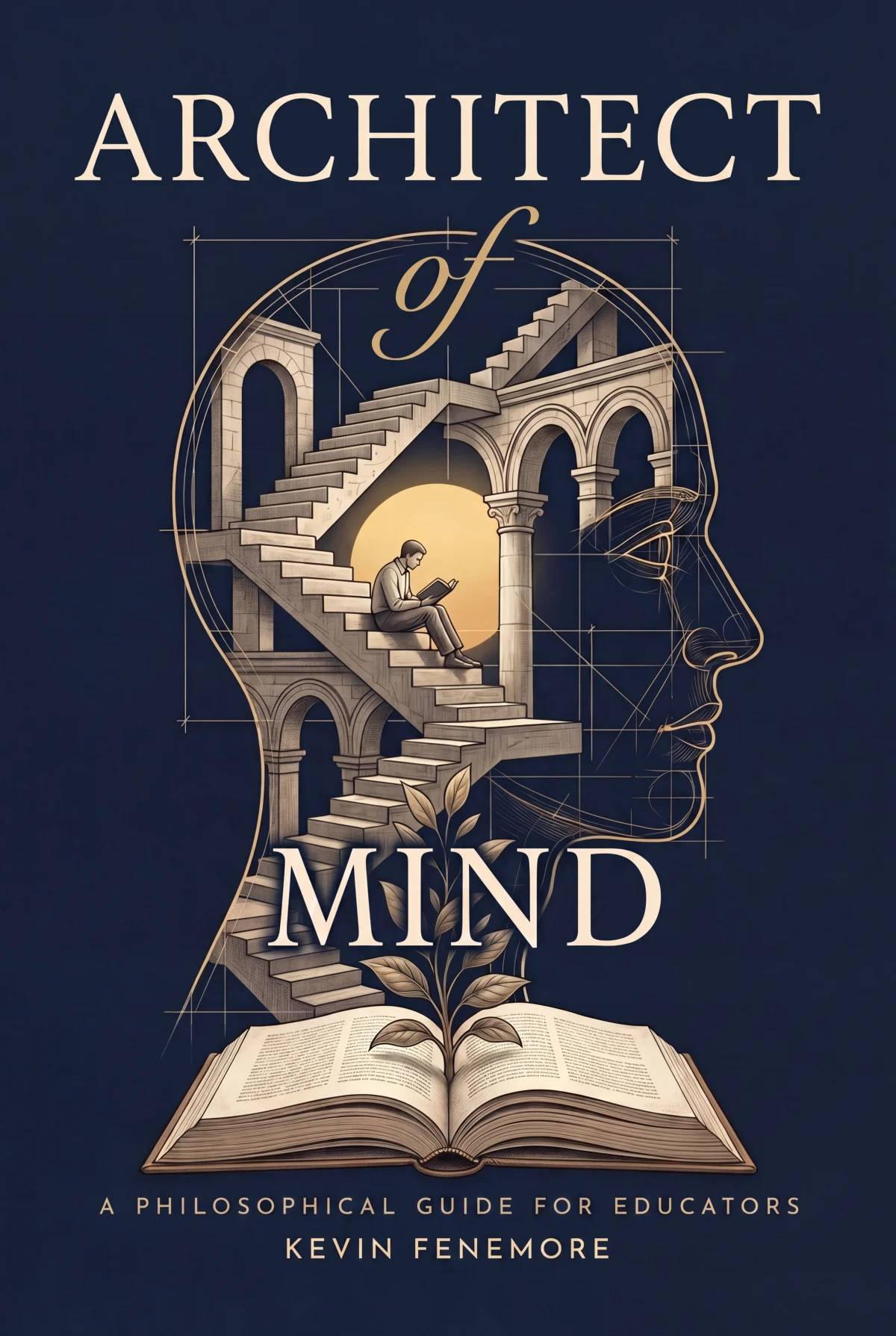
The book trailer
A short introduction to Architect of Mind — where the fifty philosophical lenses came from, and how to read the book as a working tool rather than a survey.
Watch the trailer
“You already have a philosophy of education. You just may not know what it is yet.”
A map, not a doctrine
Architect of Mind gives you access to fifty traditions, then asks you to think. The strongest educators can move between frameworks, choosing the lens that fits the learner and the decision in front of them.
No specialist background is required. Each tradition is explained through the educator it produces and the choices it makes possible.
The book moves across philosophy, psychology, neuroscience, critical theory, design and lived educational practice.
Ideas are placed in their intellectual context, then brought back to the learner, classroom, programme or conversation in front of you.
The aim is not to choose one school of thought forever. It is to know which lens helps, what it reveals and what it leaves out.
Inside the book
Each chapter turns a philosophical tradition into a living, usable educator archetype. Open a lens to inspect it.
Plus forty-one more frameworks, from The Diplomat and The Futurist to The Minimalist and The Witness.
Read inside the book
These selected pages move from cognitive science to critical, artistic and radical traditions. Use the controls, swipe, or move with the arrow keys.
Why every educator needs a map, and why no single map is enough.
Imagine two people standing at the front of the same room, facing the same group of human beings, on the same unremarkable morning. The first has spent years in rooms like it. She can read the energy of a group within minutes and respond to what is in front of her rather than what she had planned.
The second has all of that, and something else: a set of lenses. She has spent time asking not just what works, but why it works, and what assumptions about human learning, development and purpose are quietly embedded in the choices she makes every day.
The second educator is a Cartographer. This book is about becoming one.
Brain-based learning and the biology of the classroom.
There is a student who studied for three hours last night, read the chapter twice and highlighted the key passages. This morning she cannot recall the central argument. Another studied for forty minutes, closed his notes, wrote down what he could remember, checked the gaps and repeated the process. He can reconstruct the argument.
The difference is not intelligence, motivation or discipline. One happened to study in a way that aligns with how the brain consolidates information, and the other did not.
Memory is not a recording but a reconstruction. Each retrieval rebuilds the information, and effortful retrieval strengthens the pathway in ways that passive re-exposure does not.
Feminist pedagogy and the education of the whole person.
Care ethics makes a radical claim: the caring relationship between teacher and student is not a supplement to education but its moral foundation. Feminist pedagogy begins there and goes somewhere more uncomfortable.
It asks whether the structures within which that caring occurs are shaped by power, by assumptions about whose knowledge counts, and by hierarchies that determine who speaks and who listens.
The instruments used to measure intellectual and moral development are not neutral. They embed assumptions about what counts as sophisticated thinking, and those assumptions have histories.
Waldorf, Reggio Emilia and the wholeness of the learner.
Somewhere in northern Italy, in a preschool classroom in Reggio Emilia, a child is spending an entire morning studying a puddle. They are sketching it, measuring it, photographing it, discussing it and painting their theory of where it came from and where it will go.
The puddle is not a test. It is a provocation, an invitation to the full range of a child's expressive and investigative capacities, all one hundred languages offered at once.
The arts are not a supplement to the curriculum here. They are the animating principle through which thinking, feeling, observation and making remain connected.
Against the architecture, and what the architecture never saw.
There is a problem with this book. Forty-nine frameworks and forty-nine careful architectures for understanding education rest on an assumption that has not yet been examined: that education requires architecture at all.
Anarchist educational theory is not chaos or the absence of learning. It is the sustained argument that compulsory attendance, graded hierarchies, standardised curricula and credentialed gatekeeping are not neutral vessels for human development.
The chapter arrives to ask whether the most important education in your life happened outside every structure assembled in these pages, and what formal education failed to see while it was looking at its own categories.

Make the traditions already present in your practice visible, then widen the range of choices available to you.
“Imagine two teachers standing in front of the same class. One has instinct. The other has instinct and a set of lenses.”

Read Architect of Mind as a working educator or a curious outsider. It was written for both.
Get the bookAvailable as an eBook. Print edition to follow.Book and speaking enquiries
For talks, reading groups, institutional orders or discussion around the book, tell us what you are planning.
Open the enquiry formWe respond within two working days. All enquiries treated in confidence.